TL;DR:
- Fixed gear bikes cost $400-600 for quality entry models while gravel bikes start around $1,000-2,000, but fixies require almost zero maintenance long-term
- Terrain dictates everything: fixies dominate flat urban environments with instant acceleration, but gravel bikes handle hills, dirt, and mixed surfaces without the constant pedaling demands
- Maintenance reality: fixed gears need chain lube and brake pad checks; gravel bikes require derailleur adjustments, hydraulic brake bleeding, and component replacements
- Choose fixed if you ride primarily on pavement in relatively flat areas and want mechanical simplicity; choose gravel if you crave weekend adventures, tackle varied terrain, or live somewhere hilly
Your buddy just dropped $3,000 on a gravel bike and won’t shut up about “terrain versatility.” Meanwhile, you’re cruising past traffic jams on your $500 fixie 🚴♂️. So what’s the real difference here—and which bike belongs in your life?
Here’s the deal, fixed gears own the urban jungle and offer an unmatched connection to the road. The question isn’t which is superior—it’s which matches how you actually ride.
I’ve watched the gravel trend explode. Let me cut through the hype and show you exactly where each bike excels, where it falls flat, and which one you should buy based on your real riding habits.
If you’re new to fixed gear culture, check out what makes a fixed gear bike unique before diving in.
The Core Differences (What Actually Matters)
The fundamental split between these bikes comes down to one thing: how you transfer power to the wheels.
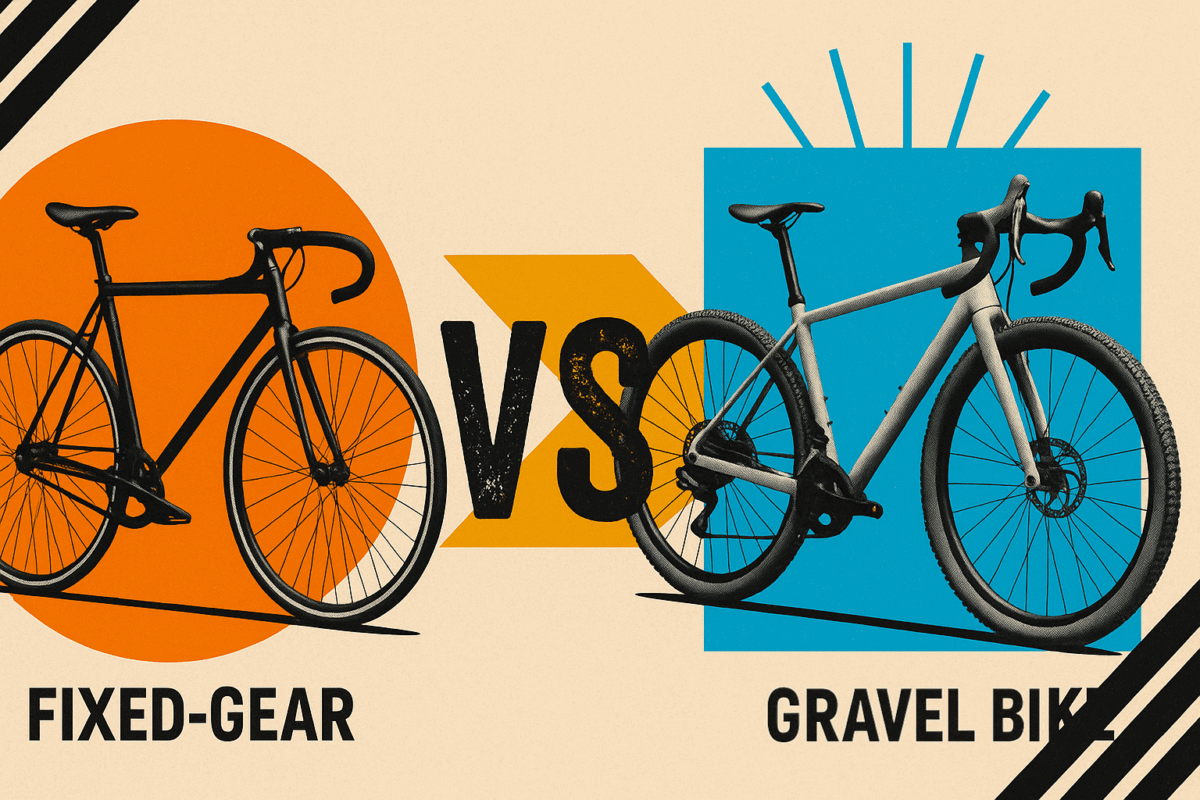
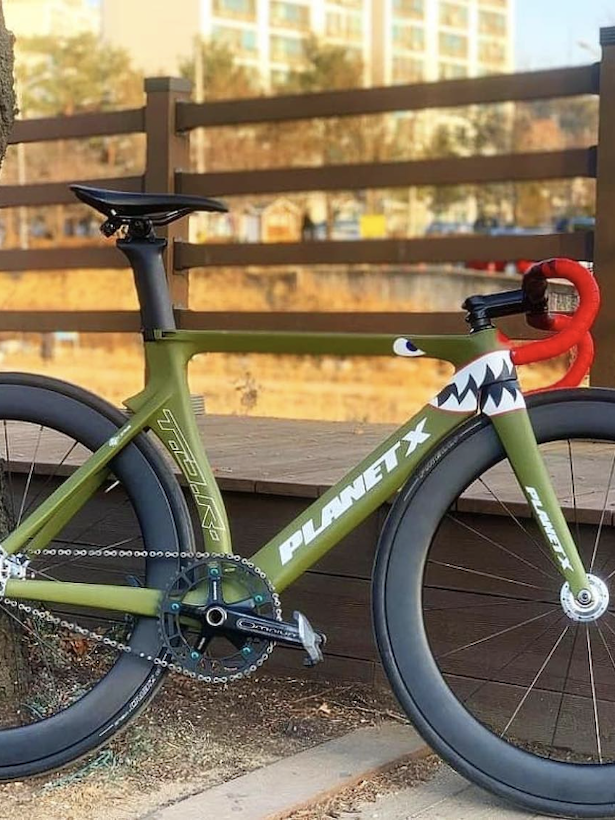
Fixed gear bikes connect your legs directly to the rear wheel through a single cog. No coasting, no gear changes, no freewheel mechanism. When the wheel spins, your pedals spin. Period.
This creates what riders describe as an almost telepathic connection to the bike—you feel every change in momentum, every bit of road texture, every shift in speed.
Gravel bikes use traditional drivetrains with anywhere from 10 to 12 gears (sometimes more). Modern gravel setups typically run either 1x (single chainring) or 2x (double chainring) configurations.

A 1x setup might pair a 40-tooth chainring with an 11-42 cassette, giving you a wide range for both climbing steep fire roads and cruising on pavement. The 2x option adds even more range, with something like a 48/32 chainring paired with an 11-34 cassette.
Here’s what that means in practice: on a fixed gear, you pick one gear ratio (commonly 48/17 or 2.82 for urban riding) and commit. That ratio works great on flat roads but becomes brutal on hills. On a gravel bike, you shift to match the terrain—easy gears for climbs, hard gears for flats.
Geometry and Handling
Track geometry on fixed gear bikes prioritizes quick steering and responsive handling. You get a steeper head tube angle (around 73-74 degrees), shorter wheelbase, and higher bottom bracket.
This makes fixies incredibly nimble in traffic—you can weave through cars, hop curbs, and change direction instantly. The trade-off? Less stability at high speeds and on rough surfaces.
Gravel bike geometry goes the opposite direction. Slacker head tube angles (around 70-71 degrees), longer wheelbases, and lower bottom brackets create a more stable platform for rough terrain.
You won’t carve through traffic gaps as easily, but you also won’t get rattled off your line when you hit a pothole at 25 mph. Think of it like comparing a sports car to an SUV—different tools for different jobs.
| Feature | Fixed Gear | Gravel Bike |
|---|---|---|
| Gearing | Single fixed ratio (typically 44/16 to 48/17) | 10-12+ speeds with wide range |
| Weight | 20-21 lbs (quality chromoly) | 22-26 lbs (varies by build) |
| Tire Width | 23-28mm | 35-50mm+ clearance |
| Brakes | Rim brakes + leg braking | Hydraulic disc brakes |
| Price Range | $400-$1,000 | $1,000-$5,000+ |
| Maintenance | Minimal (chain/brake pads) | Moderate to high |
| Best Terrain | Flat urban pavement | Mixed: gravel, dirt, pavement |
Where Each Bike Dominates
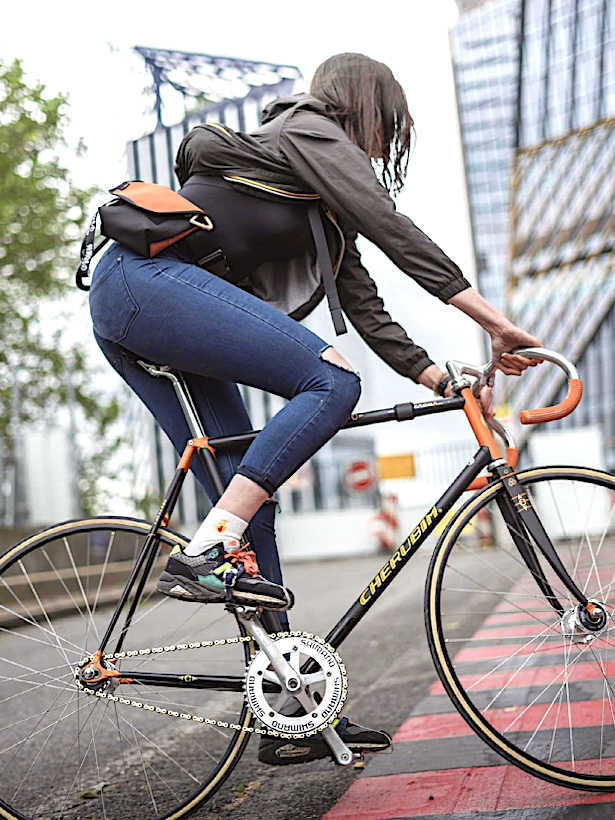
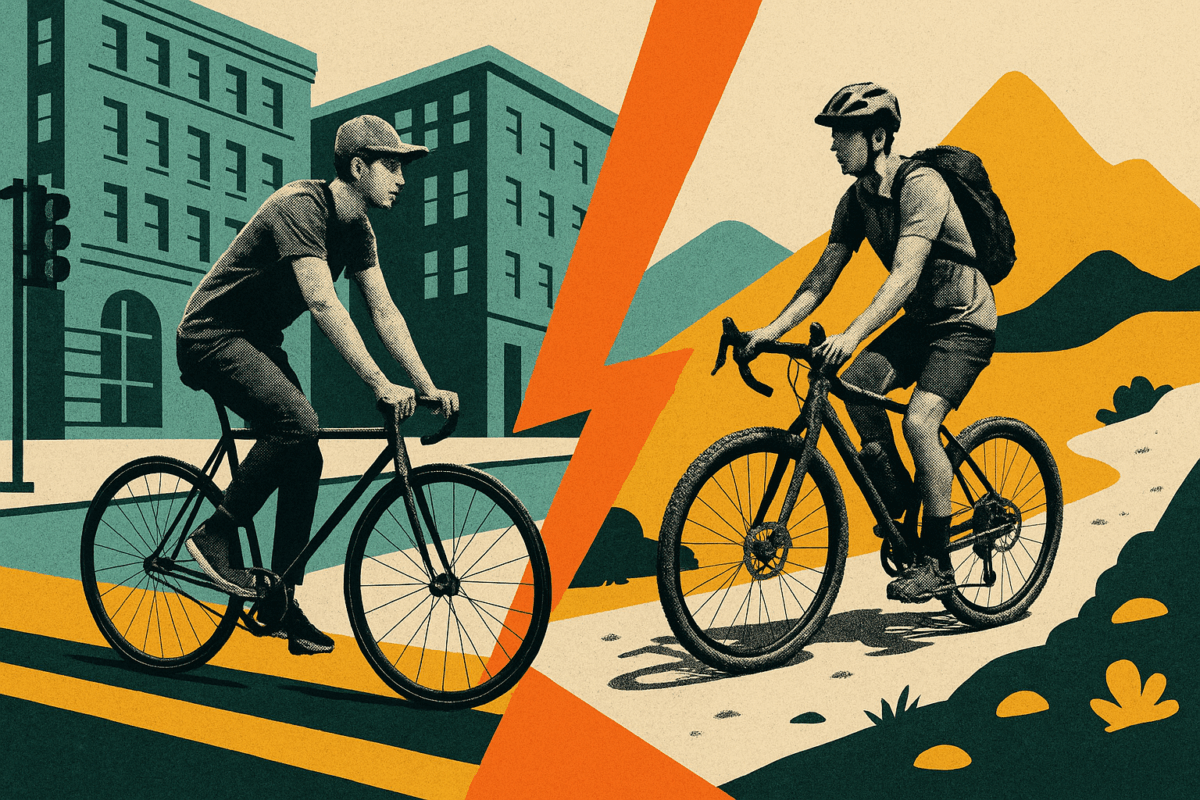
In dense city riding, fixed gears are extremely capable. The constant connection means you can accelerate faster from stoplights than most geared bikes.
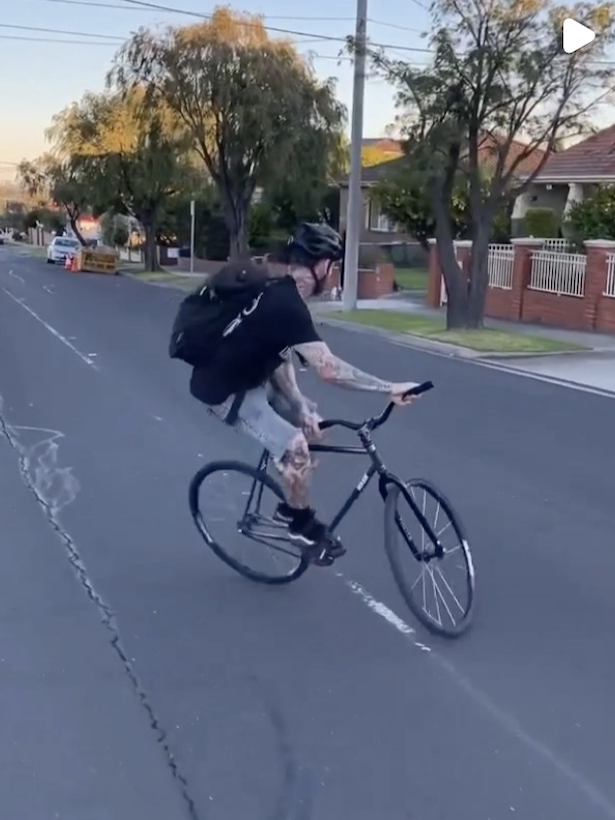
You can modulate speed with leg pressure instead of grabbing brakes constantly. And when a car door opens in front of you, that direct drivetrain lets you reverse-pressure to slow down instantly—no brake lever fumbling required.
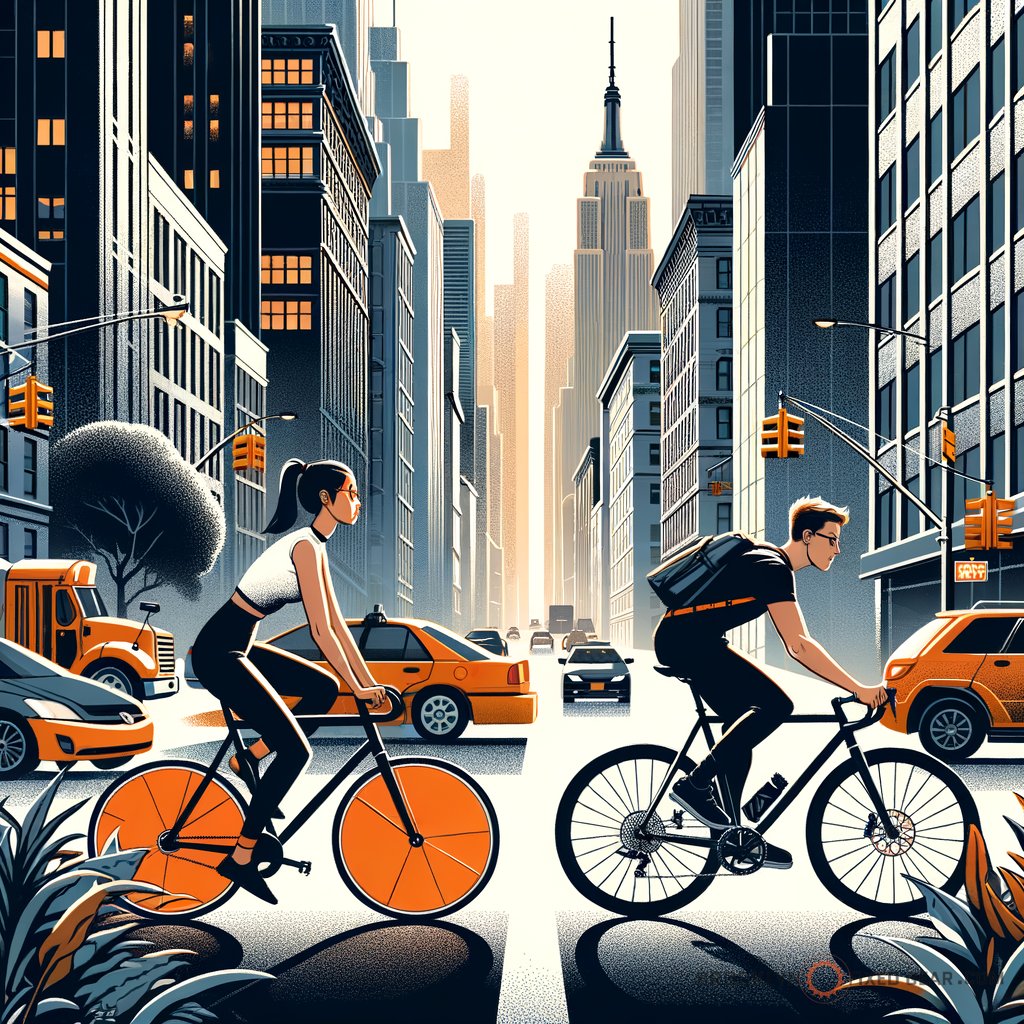
I’ve ridden fixed in Manhattan for three years. The ability to thread through traffic with zero mechanical delay between your brain and the bike’s response? That’s the whole point. Plus, when you’re hitting 30+ lights per commute, the simplified brake setup means one less thing to maintain or adjust.
The limitations? Hills expose you immediately. On a 48/17, a 10% grade becomes a quad-destroying grind. And forget about coasting—your legs are always working.
Mixed Terrain: Gravel Wins Every Time
Take that same fixed gear onto a fire road with loose gravel and 15% pitches, and you’ll understand why gravel bikes exist. The wider tires (typically 38-45mm) provide significantly more traction on loose surfaces.
The multiple gears mean you can spin up steep climbs at a comfortable cadence instead of standing and mashing. The disc brakes give you actual stopping power on descents.

Did you know?
Gravel bikes can typically clear tires up to 50mm wide, while most fixed gears max out around 28mm. That extra width provides substantially more contact with the ground, dramatically improving grip on dirt and gravel.
Gravel bikes also handle bikepacking and long-distance rides far better. Most frames come with multiple bottle cage mounts, rack mounts, and fender mounts. You can load up gear for a weekend trip without compromising handling.
Try that on a fixed gear and you’re asking for trouble—the aggressive geometry and constant pedaling don’t play nice with heavy loads.
But here’s the honest truth: if you’re riding 90% pavement and only occasionally hitting a dirt path, you don’t need a gravel bike. The extra weight and complexity only make sense if you’re regularly tackling actual gravel roads, forest paths, or technical terrain.
The right bike isn’t about which has more features—it’s about matching the tool to where you actually ride, not where you imagine riding someday.
Money Talk (Total Cost of Ownership)
Quality fixed gear bikes start around $400-600. Bikes in this range like models from State Bicycle Co. or other reputable brands get you a solid chromoly frame, sealed bearings, and components that’ll last years. Want to go cheaper? You can find entry fixies for $200-300, but quality often suffers.
Gravel bikes start at roughly $1,000-2,000 for entry-level models. The Specialized Diverge or Giant Revolt series sit in this range and offer aluminum frames with decent component groups.
Move up to $3,000-5,000 and you get carbon frames, electronic shifting, and premium wheelsets. High-end custom builds can exceed $10,000.
Maintenance
This is where the fixed gear becomes remarkably cheap to run. Your maintenance checklist looks like this:
- Chain lube every 100-150 miles
- New chain every 2,000-3,000 miles ($15-30)
- Brake pads when worn ($10-20)
- Occasional tire replacement
That’s it. No derailleur adjustments, no cassette replacements, no housing swaps, no hydraulic brake bleeds. Total annual maintenance for moderate riding? Typically around $50-100 depending on your riding volume and component quality. You can do everything yourself with basic tools.
Gravel bikes cost more to maintain.
Cables and housing stretch and need replacement. Cassettes wear out (especially with the mud and grit from gravel riding). Hydraulic brakes need bleeding. Chain replacement costs more because you’re also replacing multiple cassette cogs as they wear.
Budget roughly $200-400 annually for professional tune-ups and component replacements if you ride regularly—though this varies significantly based on riding conditions and how much work you do yourself.
Fixed Gear Annual Costs
- Chain replacement: $15-30 every 2,000-3,000 miles
- Brake pads: $10-20 as needed
- Chain lube: $10 bottle lasts months
- Tires: $30-60 per tire annually (varies by use)
- Total typical annual cost: $50-100
Who Should Ride Which Bike
Buy a Fixed Gear If You:
- Ride mostly on pavement in relatively flat urban areas
- Value mechanical simplicity and want to handle your own maintenance
- Prioritize connection to the bike over terrain versatility
- Have a tight budget and want low ownership costs
- Love the minimalist aesthetic and fixed gear culture
Don’t buy a fixed gear if you live somewhere seriously hilly. A 48/17 ratio works great in Brooklyn or Portland but becomes torture in San Francisco or Seattle. And if you regularly ride trails or unpaved roads, the narrow tires and aggressive geometry work against you.
Buy a Gravel Bike If You:
- Mix pavement with dirt roads, gravel paths, or light trails
- Take weekend adventure rides or bikepacking trips
- Live in hilly terrain where multiple gears make life bearable
- Want one bike for multiple riding styles instead of a quiver
- Prefer easier climbing and don’t mind the added complexity
Skip the gravel bike if you’re 90%+ urban commuting on flat pavement. You’re paying for versatility you won’t use, and the extra weight/complexity doesn’t add value to city riding. The wider tires also roll slower on pavement—you’ll feel the difference. For more on why some riders stick with fixed gear for urban commuting, read about the benefits of fixed gear bikes.
Frequently asked questions (FAQ)
Technically yes, but it’s not practical for most riders. You could add wider tires (if your frame clears them) and maybe a front brake, but the geometry remains wrong for gravel. The steep angles and short wheelbase that make fixies great in cities work against you on loose terrain. If you really want to try fixed-gear gravel riding, look at dedicated “tracklocross” frames designed specifically for off-road fixed gear—but know that it’s a niche within a niche. For most riders, just buy the right tool for the job.
Fixed gear bikes provide a more demanding workout because you can’t coast. Your legs are constantly moving, which builds muscular endurance and improves pedal stroke efficiency. Many road cyclists ride fixed in the off-season for exactly this reason. Gravel bikes let you control intensity through gearing and allow recovery periods through coasting, making them better for longer endurance rides. If pure leg strength and cadence work are your goals, go fixed. If you want varied terrain and longer distances, choose gravel.
Fixed gear bikes can be attractive theft targets because they’re distinctive, but they’re also typically cheaper to replace. The advantage? A $500 fixed gear is less painful to lose than a $3,000 gravel bike. Many urban riders keep a beater fixie for street parking and save their nice bikes for rides where they can maintain sight of them. If theft is a major concern, consider getting a less flashy fixed gear as your daily commuter rather than locking an expensive gravel bike on city streets.
Nope—when you’re moving forward on a fixie, your pedals are turning. The rear cog is literally fixed to the hub, so wheel rotation = pedal rotation. This is the defining characteristic of a fixed gear. You can’t coast. However, many “fixie-style” bikes have flip-flop hubs, meaning one side is fixed and the other is freewheel (single-speed that lets you coast). If you want to try fixed gear gradually, look for this setup—you can flip your wheel to try each style. Learn more about how to choose between fixed and single-speed setups.
Final Thoughts
Look, I could sit here and claim one bike is universally better, but that’s complete nonsense. I’ve logged thousands of miles on fixed gear bikes because I live in a flat city, ride primarily for commuting, and genuinely love the simplicity.
But I’ve also borrowed gravel bikes for weekend trips and immediately understood their appeal for riders tackling mixed terrain.
The right bike depends entirely on your actual riding habits, not Instagram aesthetics or what’s trending.
Ride mostly urban pavement? Get a fixed gear and save your money. Want to explore fire roads and dirt paths on weekends? You need a gravel bike. Live somewhere mountainous? Multiple gears will save your knees.
Stop overthinking it. Pick the bike that matches where you actually ride, not where you imagine riding someday.
Sources and references