








TL;DR:
- Wheels wobbling more than 5mm side-to-side need immediate attention, but 1-3mm wobbles you can handle at home with a basic spoke wrench
- The fundamental principle: Tightening a spoke pulls the rim toward that side—master this and you’ve mastered wheel truing
- Pro shop truing typically costs $20-50, while DIY requires only a spoke wrench and patience—it pays for itself after 2-3 sessions
- Fixed gear wheels are symmetric (no dish), making them easier to true than geared rear wheels since both sides have equal spoke tension
Your rear wheel’s rubbing the frame. Again 🤦. That rhythmic tick-tick-tick every revolution is driving you nuts.
Before you drop $40 at the shop, here’s what you need to know: wheel truing isn’t the dark art mechanics want you to think it is. It’s systematic spoke adjustment that anyone with basic mechanical sense can learn.
Most riders figure maintaining a fixed gear bike is already easy enough—and they’re right. But knowing how to true your own wheels? That’s next-level independence.
I’ll show you the actual process mechanics follow, explain why fixed gear wheels are simpler to true than geared wheels, and help you avoid the mistakes that turn a minor wobble into wallet damage 💡.

Did you know?
Fixed gear wheels often stay true longer than geared wheels because they don’t have the asymmetric spoke tension (dish) that causes one side to loosen faster. That symmetry is one of many benefits of riding fixed.
What Wheel Truing Actually Means (And Why It Matters)
Wheel truing is adjusting spoke tension to fix straightness and roundness. Two types matter: lateral true (side-to-side wobble) and radial true (up-and-down wobble).

Lateral truing corrects those side-to-side wobbles—the ones that make your rim kiss the brake pads. This is what causes that annoying rub you’re hearing. Radial true is the wheel’s roundness—how much it hops up and down as it spins.
Wheels go out of true from normal riding. When you ride, the wheel flattens slightly where it meets ground, causing spokes at the bottom to temporarily lose tension. Over time—we’re talking hundreds of miles—this constant tension cycling loosens spokes.
Hit a pothole hard? That impact can knock multiple spokes out of position instantly.
For fixed gear riders, lateral true matters most. You’re skidding, applying constant tension through the drivetrain, and running tight chainlines. A wobbly wheel doesn’t just rub—it affects your skid patches and can cause chain drop.
The silver lining? Fixed gear wheels are symmetrical with no dish, meaning both sides should have equal spoke tension. This actually makes them easier to true than geared rear wheels where one side typically runs 40-50% tighter than the other.

Fun Fact: Professional track wheels are sometimes built to spoke tensions exceeding 130 kgf (kilogram-force)—significantly higher than typical road wheels—because the symmetric build allows it without rim failure.
Can You Actually Fix This Yourself?
Straight talk: yes, but what’s wrong matters.
If you’re seeing minor wobbles (a few millimeters), there’s no reason you can’t handle this. The process is methodical and forgiving. I’ve watched riders who’d never touched a spoke wrench get their wheels rideable in 30 minutes flat.
You can fix:
- Minor lateral wobble (1-3mm deviation)
- Light radial hops
- Loose spokes causing small deviations
- Wheels that went slightly out after normal riding
Take it to a shop when you’ve got:
Broken or bent spokes (can’t true around missing tension), major wobbles (4mm+) or visible rim distortion, dented or cracked rims (structural damage), stripped nipples that won’t turn anymore, or wheels that taco’d from a crash.
Professional truing typically costs $20-50 depending on your city and wheel condition, though some shops charge as low as $15 while high-end shops can hit $65. If you’re looking at multiple broken spokes or obvious rim damage, that shop fee might be your smartest move.
The beautiful part about trying it yourself? You’re unlikely to do permanent damage. The worst you’ll typically do is overtension a spoke to breaking or strip the nipple threading.
Even then, you can replace that spoke and try again. It’s not like you’re going to magically destroy the rim by turning nipples (unless you really try).
DIY Approach
- Minor wobbles (1-3mm)
- Normal maintenance truing
- Learning experience
- $8-13 spoke wrench investment
- Works on your schedule
Professional Shop
- Broken spokes
- Severe rim damage
- Complex repairs
- $20-50 per wheel typically
- Guarantees results
Tools You Need (And What You Don’t)
Here’s your actual shopping list—not the full wheelbuilder’s workshop.
Essential gear:
- Spoke wrench in the correct size for your nipples (usually 3.23mm for most fixed gear wheels)
- Your bike (we’re flipping it upside down)
- Zip tie or chalk to mark wobbles
- Good lighting (seriously—you need to see what you’re doing)
- Patience (can’t buy this one)
The Park Tool SW-0 spoke wrench costs around $8-9 and fits the 3.23mm nipples found on higher-end wheels. The SW-7.2 triple spoke wrench runs $9.50-12.95 and fits the three most common sizes—smart choice if you’re unsure of your nipple size or work on multiple bikes. That’s what I bought first. One wrench, fits everything, no guessing games.

Critical warning!
Wrong-sized spoke wrench will round off nipples since they’re made of soft brass or aluminum. Once rounded, they’re nearly impossible to adjust. You’ll need to replace the spoke. Measure your nipples with calipers or buy a multi-size wrench. Don’t cheap out here.
Nice to have (but skip for now):
- Truing stand (makes precision work easier)
- Spoke tension meter (helpful for precision work)
- Dish alignment gauge (less relevant for fixed gear wheels)
Professional truing stands like the Park Tool TS-2 series run $225-300. Budget alternatives cost $100-160. Here’s my take: if you’re truing once every few months, you don’t need one. Your bike frame works fine. Save the $200+ and flip your bike upside down.
If you’re building wheels from scratch or truing weekly? Then yeah, spring for the stand. Otherwise, it’s overkill.
How Spoke Adjustment Actually Works
Understanding the mechanics makes everything click. Your wheel is held together by spoke tension—spokes pull the hub up from the bottom, while top spokes prevent excessive compression. It’s a constant state of balanced tension keeping everything centered.
Spokes coming from the right side hub flange pull the rim to the right. Spokes from the left pull it left. They’re arranged in a left-right-left-right pattern at the rim, creating opposing forces.
The fundamental principle: Tightening a spoke pulls the rim TOWARD that side. Loosening pushes it away. That’s it. That’s the secret.
Here’s the counterintuitive part: Looking at the nipple from above (through the rim), it tightens clockwise—standard threading. But when you’re looking at it from the truing stand or from underneath your flipped bike, it appears to tighten counterclockwise since the nipple looks upside down.
Always rotate the wheel to bring the nipple to the top before adjusting to avoid confusion. Your brain will thank you.
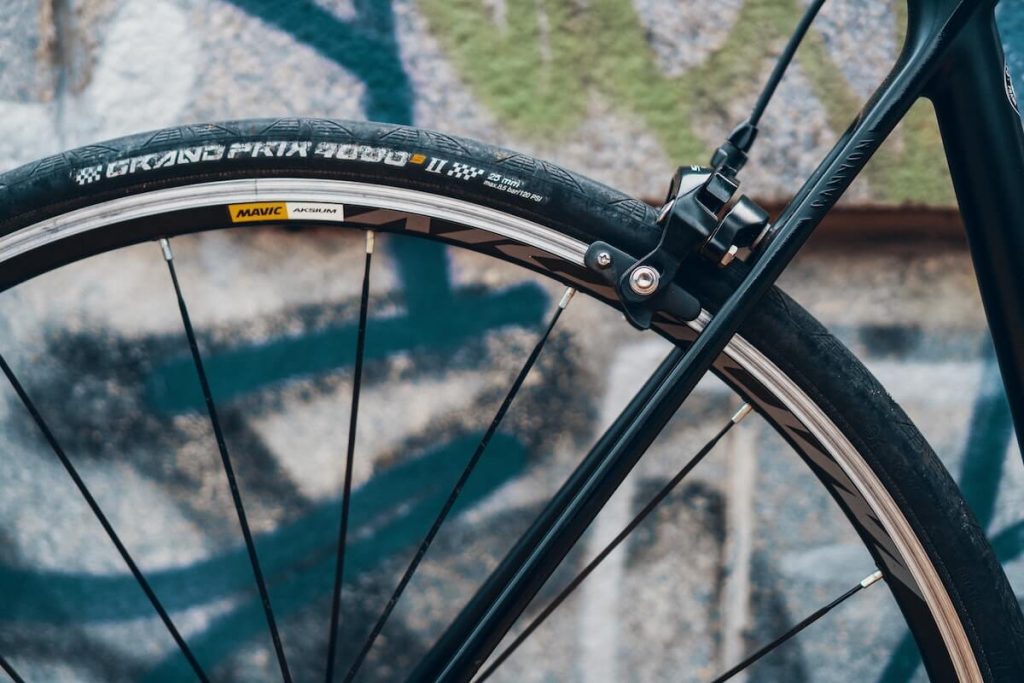
Small adjustments compound. Three spokes each getting a quarter turn has more effect than one spoke getting three quarters. Make quarter-turn adjustments maximum, reducing to eighth-turns as you get closer to true. Patience pays.
Fixed gear advantage: Your wheels likely have 32 or 36 spokes in a symmetrical pattern. Unlike geared rear wheels that are dished (offset) to clear cassettes, fixed gear wheels have equal spoke tension on both sides.
No compensation for dramatically different tensions. No second-guessing which side needs what. Just even tension all around. Simpler.
Step-by-Step: Truing Without a Stand
Let’s do this. You’ll use your bike frame as the truing stand—it’s how riders have fixed wheels on the road for decades.
Step 1: Find the Wobble
Flip your bike upside down. Or use a repair stand if you’ve got one handy. You can remove the wheel or leave it in the frame—either works.
Spin the wheel slowly. Attach a zip tie to your fork or chainstays, positioning it 1-2mm from the rim sidewall. This is your reference pointer. As the wheel spins, watch where the rim pulls closest to or away from your zip tie.
Mark high spots with chalk or tape. I like using painter’s tape—doesn’t leave residue. Check lateral deviation first (side-to-side), then radial (up-and-down). Focus on lateral true initially since that’s what causes brake rub and actually affects riding.
Step 2: Identify Which Spokes to Adjust
Stop the wheel at the worst wobble. Look at the spokes in that section. If the rim deviates to the left, you need to tighten spokes on the right side (pulling rim back right) or loosen spokes on the left (releasing the pull left).
Think opposite. Rim goes left, adjust right. Rim goes right, adjust left.
Mark the center spoke of the affected zone with tape. This is your primary adjustment spoke. The 2-3 spokes on each side of it get progressively smaller adjustments. You’re feathering the correction across multiple spokes.
Step 3: Make Adjustments
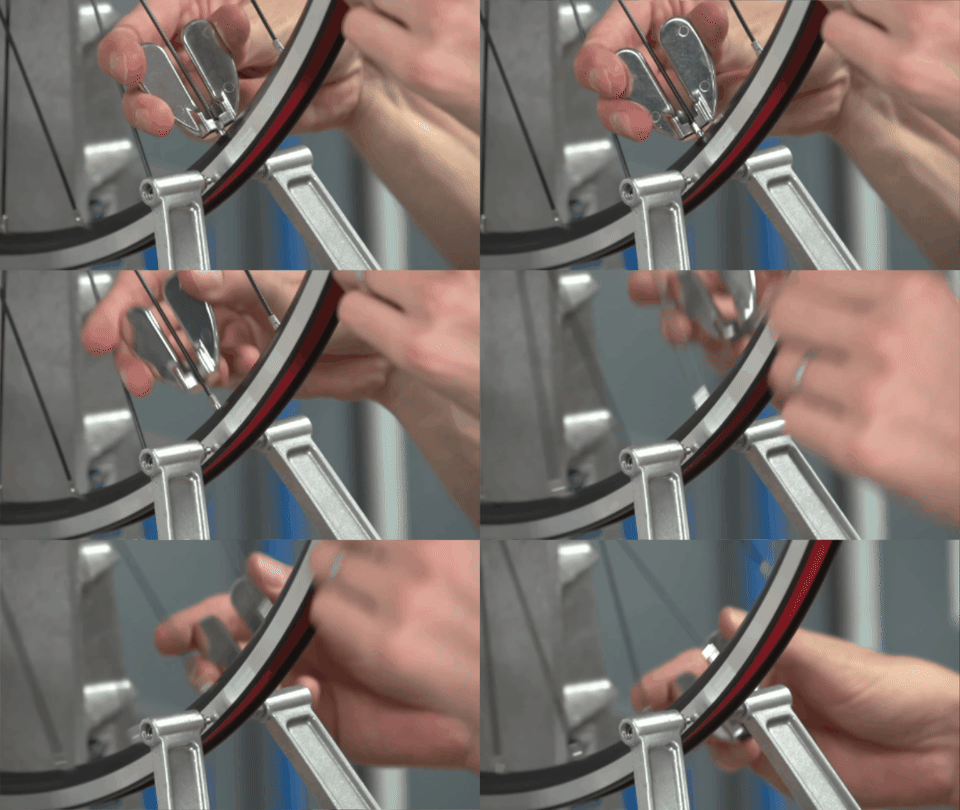
Start conservative. Turn the center nipple 1/2 turn, then back off 1/4 turn. This prevents spoke wind-up caused by the nipple twisting the spoke as you turn it. Net result: 1/4 turn adjustment without the spoke storing twist energy that’ll unwind later.
Adjacent spokes: 1/8 turn on each side. Feather it. Don’t hammer one spoke. After adjustments, give adjacent spokes a soft squeeze to help them settle into position. This releases any binding.
Re-spin and check. Did it improve? Repeat with smaller adjustments. Did it get worse? Reverse what you did and think through which spokes you should actually be adjusting. It happens. No shame in backing out a mistake.

Warning…
If you find yourself making multiple full turns on a single spoke, stop. You’re either adjusting the wrong spoke or you’ve got a bigger problem (like a bent rim) that spoke adjustment can’t fix. Back off and reassess.
Step 4: Work Around the Wheel
Start at the valve hole to give yourself a reference point. Work methodically around the wheel. Don’t jump randomly between problem areas—systematic progression prevents you from getting lost in what you’ve already done.
As you dial in one section, another might become visible. That’s normal and expected. You’re essentially averaging out imperfections across the entire rim. Getting within ±0.5mm lateral true and ±10% spoke tension deviation is generally acceptable for a functional, reliable wheel.
Perfect true (under 0.1mm) is nice but unnecessary unless you’re racing or running rim brakes with extremely narrow clearance.
Step 5: Check Spoke Tension
Squeeze pairs of parallel spokes together. They should feel similar—not identical, but close. Pluck spokes like guitar strings. Spokes of the same length and thickness should produce similar musical tones, indicating equal tension. Higher pitch = tighter spoke.
On fixed gear wheels, tension should be consistent all around since there’s no dish. If you find dramatically looser spokes (dead spots that don’t ring when plucked), work those up to match their neighbors gradually. Don’t yank them tight in one session—bring them up over a few rounds of adjustments.
Don’t obsess over perfect tension without a tensiometer. As long as spokes aren’t loose enough to rattle and none are so tight they’re deforming the rim, you’re in good shape for daily riding.
Most fixed gear riders can get a wheel rideable in 20-30 minutes once they understand the basic principle. Perfect takes longer, but rideable? That’s achievable on your first try.
When to Give Up and Visit the Shop
Zero shame in recognizing your limits. Some wheels are beyond home repair. Pushing it can make things worse and more expensive.
Red flags to stop immediately:
- Nipples won’t turn despite proper wrench size (corrosion or seized threads)
- Spoke breaks during your truing attempt
- You’re making it worse after multiple attempts (spinning your wheels, literally)
- Rim has visible dents, dings, or bulges
- More than one broken spoke already
One mechanic on a bike forum described overtightening a spoke so badly that “the nipple shot out and dented my metal garage wall.” Don’t be that guy. If it feels like you’re forcing it, stop.
Professional truing typically runs $20-50, with some shops charging $15-25 for basic work while high-end shops in major cities can charge $40-65.
If you’ve got a $150 wheelset and it needs a new rim anyway, buying fresh wheels might make more sense than sinking $80 into repairs on compromised components. Do the math on your specific situation.
Sometimes the best use of your time is letting someone with a truing stand and 1,000 wheels under their belt knock it out in 15 minutes while you grab coffee. I’m all for DIY, but I’m also for picking your battles.
Keeping Wheels True Longer
Prevention beats correction. Always.
Monthly spoke tension checks: Squeeze spokes in pairs, listen for loose ones. Spokes that are too loose will continue to loosen, requiring constant re-truing—and eventually breaking. Catching them early takes 30 seconds and saves you an hour of truing later.
Avoid impacts: Potholes, curbs, and sewer grates are wheel killers. Ride light over rough stuff. Watch the road ahead. Sometimes unavoidable, but awareness helps. If you slam something hard, check your wheels before your next ride. Spin them, look for wobbles, squeeze spokes. Five-minute check can prevent a mechanical later.
Proper tire pressure: Underinflated tires let more impact reach your rims. Each pothole hits harder. Run your tires at recommended pressure for your weight, riding style, and tire width—many fixed gear street setups run 90-110 psi, though this varies with tire size. It’s one of those boring maintenance tasks that actually matters.
Post-skid inspection: If you’re skidding hard on the street, periodically check rear wheel tension. The constant drivetrain stress from backpedaling and skid stopping can work spokes loose faster than normal riding. Not saying don’t skid—just stay aware. Check tension every few weeks if you’re a heavy skidder.
What makes wheels go out of true:
- Loose spokes that weren’t properly tensioned initially (builder error)
- Impact damage (potholes, crashes, jumping off curbs like you’re 17 again)
- Worn rim brake surfaces causing uneven rim structure
- Poor initial wheel build with uneven tension (cheap factory wheels)
- Normal fatigue over thousands of miles (eventually everything loosens)
True wheels aren’t magic—they’re well-maintained wheels. Check them regularly, address small issues before they become big ones, and they’ll stay rideable for years. I check mine monthly. Takes two minutes. Saved me countless shop trips.
Frequently Asked Questions
Frequently asked questions (FAQ)
Your first attempt will probably eat 45-60 minutes for a wheel with minor wobble. You’ll spend time figuring out which spokes to adjust, second-guessing yourself, and making small corrections. With practice, basic truing becomes a 15-20 minute job. Professional mechanics can true a wheel in under 10 minutes because they’ve done it hundreds of times and don’t think—they just do.
Yes—just flip the bike upside down and use zip ties attached to the fork or stays as reference points. This works fine for minor adjustments and is actually how many riders handle truing on the road when they hit something. Removing the wheel gives better access and visibility but isn’t required for basic work. I rarely remove wheels for minor truing.
Overtightening can break the spoke, strip the nipple threading, or pull the rim into a potato chip shape. In extreme cases, nipples can pull through the rim entirely, requiring rim replacement. Start conservative with quarter-turns and work up gradually. Wheels don’t need to be piano-string tight—they need to be evenly tensioned.
Getting within 0.5mm lateral deviation is generally acceptable for most riding. Perfect true (under 0.1mm) is nice but unnecessary unless you’re racing or running rim brakes with extremely narrow clearance. If your wheel isn’t rubbing anything and spins smoothly, it’s true enough. Don’t chase perfection on your first build.
No. Broken spokes prevent proper truing because the rim can’t be held in position correctly—there’s literally nothing holding that section of rim. Replace broken spokes first, then true the wheel. Attempting to true around broken spokes just creates uneven tension that will cause more spokes to fail. Fix the root problem first.
The process is identical, but front wheels are generally easier since they’re symmetrical and see less stress (no drivetrain forces). Rear geared wheels have dish (asymmetric spoke tension), making them trickier. Fixed gear rear wheels are symmetric like fronts, so they true just as easily—one of many advantages of riding fixed.
Final Thoughts
Learning to true your own wheels isn’t about becoming a master wheelbuilder. It’s about bike independence and understanding how your ride works. That spoke wrench pays for itself after two truing sessions. Knowing you can fix a wobble at home (or on the road) beats the money saved.
Start with minor adjustments on wheels that aren’t catastrophically out of true. Get a feel for how spoke tension affects rim position.
Make mistakes on wheels you don’t care about if possible—old wheels are great practice. And remember: wheels are surprisingly forgiving. Give it a shot.
For fixed gear riders specifically, you’re working with simpler wheels than geared riders deal with. No dish. Symmetric tension. Typically robust construction. Take advantage. Your wheels want to stay true—sometimes they just need minor help getting back there.
And if you’re interested in building your first fixed gear, knowing how to true wheels is a skill that’ll serve you forever.
Sources and references
- Park Tool – Wheel Truing Guide
- Park Tool – Spoke Tension Measurement
- Sheldon Brown – Check Spoke Tension by Ear
- Bicycles Stack Exchange – Should an Amateur Attempt Truing
- Bike Forums – Failed First Wheel Truing Attempt
- Bicycling Magazine – How to True a Bike Wheel
- Bike Forums – How Much Does Wheel Truing Cost
- Bike Forums – Fixed Gear Spoke Tension Discussion